
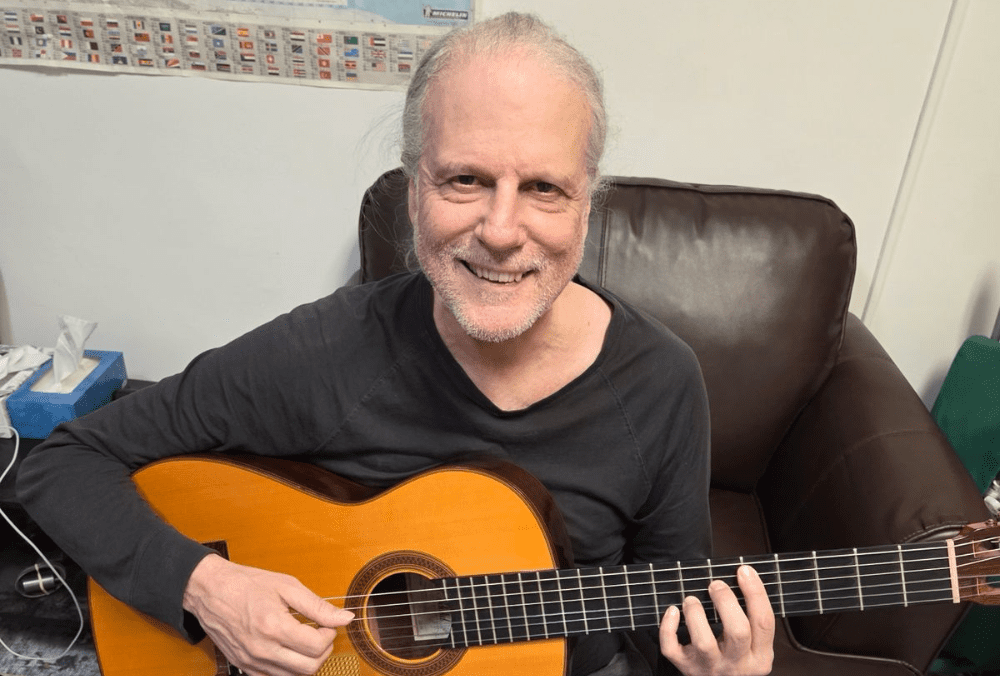
In an era where speed often outweighs precision, Sandy Ortega moves in the opposite direction. His relationship with the Spanish guitar is rooted in deep technical discipline, shaped by isolation, and guided by a lifelong commitment to sound rather than spectacle. In this conversation, Ortega speaks candidly about honoring tradition while quietly bending its rules, the patience required to master el toque, and why silence plays as crucial a role in his compositions as the notes themselves. Touching on craft, lineage, and the evolving edges of his musical identity, the interview offers a rare look into how his work continues to develop far beyond expectation, trend, or category.
Q: The Spanish guitar carries centuries of tradition. How do you decide when to honor that lineage and when to quietly bend the rules?
A: I absolutely honor the lineage I emulate the great Spanish guitar and other great composers of the Romantic Era and there are more emulations on my part. But you try to make it your own YOU your unique SOUND. So the rules are bent from the onset of serious practice to master the Spanish guitar. When my SOUND came out a number of years ago this is when I consciously bent the rules yes quietly.
Q: Are there specific technical limitations you intentionally leave in your playing because they serve the music better than perfection?
A: I learned the Classical Guitar Technique when I was a child. But my hands are not my own the are given to the higher power. So the limitations are few but I would say the arpeggios and that unmistakable Spanish accent it is just that they are so exquisitely beautiful never totally there always perfecting.
Q: What part of your technique took the longest to truly master — and what are you still actively unlearning?
A: Absolutely EL TOQUE THE SPANISH TOUCH. This is the source of BEAUTIFUL it took the longest to truly master but I have it now! What I am still actively unlearning is the time signature my compositions are without a time signature unique.
Q: How does silence function in your creative life when everything around us competes for constant noise?
A: Especially when I compose! There is silence between each phrase when I compose and practice these and perform of course. The silence is present a presence to utterly anticipate the next phrase.
Q: Are there non-musical influences shaping your work right now — architecture, literature, routine, or even physical movement?
A: There is isolation Spanish guitar is so demanding I thrive on that isolation just me my guitar my hands are not my own.
Q: What’s something outside of music that unexpectedly sharpened your focus as an artist?
A: It is extremely recent I met a lovely lady.
Q: Spanish guitar is often framed through cultural expectations. Have you ever felt boxed in by how audiences assume your music should sound?
A: My hands are not my own. What comes out comes out it is of course exquisitely beautiful so that freedom to express and whatever it is and it is truly the Spanish sound-I am furthest away from being boxed in.
Q: Do you feel your role is more about preservation, evolution, or quiet resistance?
A: There is a resistance in this country we all resist.
Q: How do you know when a piece is finished — is it a technical decision or a practical one?
A: It is a technical decision but I try not to make the composition too too long. I know from my phrasing numerous phrases make up the whole song so when I am running out of phrases to create then I am coming to the end. Technically a composer would think there is a beautiful ending now let me put it in. I don’t do this I could but you know my hands are not my own the phrases are…
Q: Is there a direction you haven’t explored yet because it requires a different version of yourself?
A: YES definitely a jazz influence but keeping it absolutely Spanish difficult but it is there all of it to explore! This Eastern influence! I am a member of the EASTERN Orthodox Church. My compositions are grounded in this Eastern influence jazz is Eastern. I must therefore explore jazz BUT keep it Spanish! So it is a different version of myself in this Western culture.
Q: When you imagine your catalog years from now, what do you hope stays consistent across it?
A: I hope that what stays consistent across it is that my hands are not my own.